

Hello. I'm writer Antoinette Beard/Sorelle Sucere... WOO-HOO!!!... Here are quirky fascinations of the Victorian to the Edwardian age, and some things that happened later that were just too bizarre to resist... Such a yummy time of quaintness & blossoming industry. Scroll down for a multitude of coolness... Ha-ha-ha, always there are those who flaunt conventions, Darlings... ;)

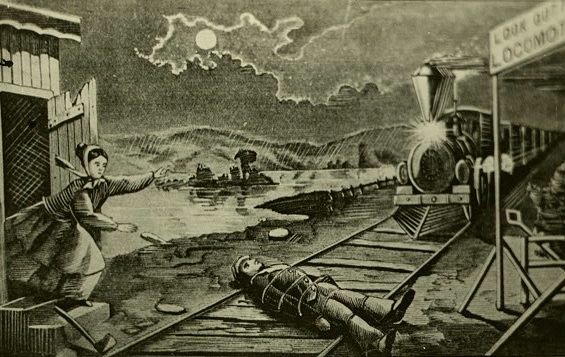
MOST PEOPLE ARE FAMILIAR WITH that most clichéd of old cinema tropes: the damsel-in-distress, tied to the railroad tracks by a dastardly villain, only to be saved at the last moment by the dashing hero.
As a method of murder, this seems so melodramatic and old-timey that it must have originated back in the days of the silent film. But that scene rarely ever occurred, and probably not in the way you think it did.
“It’s really a tricky subject because people have this incredibly specific trope in mind (villain in top hat and mustache, screaming female victim, said villain tying or chaining said victim to tracks),” says Fritzi Kramer, creator of the silent film blog, Movies Silently. “But then when they are told that it was not actually common in silent film, they quickly grab for something, anything to prove that it happened.”


Moriarty is highly ruthless, shown by his steadfast vow to Sherlock Holmes that "if you are clever enough to bring destruction upon me, rest assured that I shall do as much to you".[8] Moriarty is categorized by Holmes as an extremely powerful criminal mastermind adept at committing any atrocity to perfection without losing any sleep over it. It is stated in "The Final Problem" that Moriarty does not directly participate in the activities he plans, but only orchestrates the events or provides the plans that will lead to a successful crime. What makes Moriarty so dangerous is his extremely cunning intellect:
Holmes echoes and expounds this sentiment in The Valley of Fear, stating:
Moriarty respects Holmes's intelligence, stating: "It has been an intellectual treat for me to see the manner in which you [Holmes] have grappled with this case." Nevertheless, he makes numerous attempts upon Holmes's life through his agents. He shows a fiery disposition, becoming enraged when his plans are thwarted, resulting in his being placed "in positive danger of losing my liberty". While personally pursuing Holmes at a train station, he furiously elbows aside passengers, heedless of whether this draws attention to himself.
Doyle's original motive in creating Moriarty was evidently his intention to kill Holmes off. "The Final Problem" was intended to be exactly what its title says; Doyle sought to sweeten the pill by letting Holmes go in a blaze of glory, having rid the world of a criminal so powerful and dangerous that any further task would be trivial in comparison (as Holmes says in the story itself). Eventually, however, public pressure and financial troubles impelled Doyle to bring Holmes back. While Doyle conceded to revealing that Holmes did not die during "The Final Problem" (as Watson mistakenly concludes), he chose not to undo Moriarty's death in a similar fashion. For this reason, the later novel The Valley of Fear features Moriarty as an active villain but is specified to take place before the events of "The Final Problem".
Perhaps, murdered in 1880 with the help of her cousin.
The phrase "House of the Rising Sun" is often understood as a euphemism for a brothel, but it is not known whether the house described in the lyrics was an actual or a fictitious place. One theory is that the song is about a woman who killed her father, an alcoholic gambler who had beaten his wife. Therefore, the House of the Rising Sun may be a jailhouse, from which one would be the first person to see the sunrise (an idea supported by the lyric mentioning "a ball and chain", though that phrase has been slang for marital relationships for at least as long as the song has been in print). Because women often sang the song, another theory is that the House of the Rising Sun was where prostitutes were detained while being treated for syphilis. Since cures with mercury were ineffective, going back was very unlikely.
Only three candidates that use the name Rising Sun have historical evidence—from old city directories and newspapers. The first was a small, short-lived hotel on Conti Street in the French Quarter in the 1820s. It burned down in 1822. An excavation and document search in early 2005 found evidence that supported this claim, including an advertisement with language that may have euphemistically indicated prostitution. Archaeologists found an unusually large number of pots of rouge and other cosmetics at the site.
The second possibility was a "Rising Sun Hall" listed in late 19th-century city directories on what is now Cherokee Street, at the riverfront in the uptown Carrollton neighborhood, which seems to have been a building owned and used for meetings of a Social Aid and Pleasure Club, commonly rented out for dances and functions. It also is no longer extant. Definite links to gambling or prostitution (if any) are undocumented for either of these buildings.
A third was "The Rising Sun", which advertised in several local newspapers in the 1860s, located on what is now the lake side of the 100 block of Decatur Street. In various advertisements it is described as a "Restaurant", a "Lager Beer Salon", and a "Coffee House". At the time, New Orleans businesses listed as coffee houses often also sold alcoholic beverages.
Dave Van Ronk wrote in his biography The Mayor of MacDougal Street that at one time when he was in New Orleans someone approached him with a number of old photos of the city from the turn of the century. Among them "was a picture of a foreboding stone doorway with a carving on the lintel of a stylized rising sun ... It was the Orleans Parish women's prison".
Bizarre New Orleans, a guidebook on New Orleans, asserts that the real house was at 1614 Esplanade Avenue between 1862 and 1874 and was said to have been named after its madam, Marianne LeSoleil Levant, whose surname means "the rising sun" in French. The big house still stands today,and has been cut into about seven apartments.
 Another guidebook, Offbeat New Orleans, asserts that the real House of the Rng Sun was at 826–830 St. Louis St. between 1862 and 1874, also purportedly named for Marianne LeSoleil Levant. The building still stands, and Eric Burdon, after visiting at the behest of the owner, said, "The house was talking to me"..
There is a contemporary B&B called the House of the Rising Sun, decorated in brothel style. The owners are fans of the song, but there is no connection with the original place.
Not everyone believes that the house actually existed. Pamela D. Arceneaux, a research librarian at the Williams Research Center in New Orleans, is quoted as saying: