Saturday, September 1, 2018

Absinthe, --- "The Green Fairy," - Part 1...


Absinthe  is historically described as a distilled, highly alcoholic ( 90–148 U.S. proof) beverage. It is an anise-flavoured spirit derived from botanicals, including the flowers and leaves of Artemisia absinthium ("grand wormwood"), together with green anise, sweet fennel, and other medicinal and culinary herbs.
Absinthe traditionally has a natural green colour but may also be colourless. It is commonly referred to in historical literature as "la fée verte" (the green fairy). Although it is sometimes mistakenly referred to as a liqueur, absinthe is not traditionally bottled with added sugar; it is therefore classified as a spirit.[6] Absinthe is traditionally bottled at a high level of alcohol by volume, but it is normally diluted with water prior to being consumed.
Absinthe originated in the canton of Neuchâtel in Switzerland in the late 18th century. It rose to great popularity as an alcoholic drink in late 19th- and early 20th-century France, particularly among Parisian artists and writers. Owing in part to its association with bohemian culture, the consumption of absinthe was opposed by social conservativesand prohibitionists. Ernest Hemingway, James Joyce, Charles Baudelaire, Paul Verlaine, Arthur Rimbaud, Henri de Toulouse-Lautrec, Amedeo Modigliani, Pablo Picasso, Vincent van Gogh, Oscar Wilde, Marcel Proust, Aleister Crowley, Erik Satie, Edgar Allan Poe, Lord Byron and Alfred Jarry were all known absinthe drinkers.
Absinthe has often been portrayed as a dangerously addictive psychoactive drug and hallucinogen. The chemical compound thujone, although present in the spirit in only trace amounts, was blamed for its alleged harmful effects. By 1915, absinthe had been banned in the United States and in much of Europe, including France, the Netherlands, Belgium, Switzerland and Austria-Hungary. Although absinthe was vilified, it has not been demonstrated to be any more dangerous than ordinary spirits. Recent studies have shown that absinthe's psychoactive properties (apart from that of the alcohol) have been exaggerated.
A revival of absinthe began in the 1990s, following the adoption of modern European Union food and beverage laws that removed longstanding barriers to its production and sale. By the early 21st century, nearly 200 brands of absinthe were being produced in a dozen countries, most notably in France, Switzerland, Australia, Spain, and the Czech Republic.

Friday, August 31, 2018

"Step in time!!!," With The Chimney Sweeps, From "Mary Poppins"...

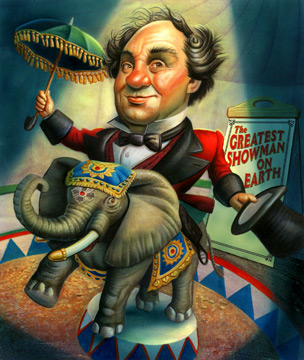
The Flamboyant P.T. Barnum...


P. T. Barnum was considered the father of modern-day advertising, and one of the most famous showmen/managers of the freak show industry.  In the United States he was a major figure in popularizing the entertainment. However, it was very common for Barnum's acts to be schemes and not altogether true. Barnum was fully aware of the improper ethics behind his business as he said, "I don't believe in duping the public, but I believe in first attracting and then pleasing them." During the 1840s Barnum began his museum, which had a constantly rotating acts schedule, which included The Fat Lady, midgets, giants, and other people deemed to be freaks. The museum drew in about 400,000 visitors a year.
P.T. Barnum’s American Museum was one of the most popular museums in New York City to exhibit freaks. In 1841 Barnum purchased The American Museum, which made freaks the major attraction, following mainstream America at the mid-19th century. Barnum was known to advertise aggressively and make up outlandish stories about his exhibits. The façade of the museum was decorated with bright banners showcasing his attractions and included a band that performed outside. Barnum’s American Museum also offered multiple attractions that not only entertained but tried to educate and uplift its working-class visitors. Barnum offered one ticket that guaranteed admission to his lectures, theatrical performances, an animal menagerie, and a glimpse at curiosities both living and dead.
One of Barnum's exhibits centered around Charles Stratton, the dwarf "General Tom Thumb" who was then 4 years of age but was stated to be 11. Charles had stopped growing after the first 6 months of his life, at which point he was 25 inches (64 cm) tall and weighed 15 pounds (6.8 kg). With heavy coaching and natural talent, the boy was taught to imitate people from Hercules to Napoleon. By 5, he was drinking wine, and by 7 smoking cigars for the public's amusement. During 1844–45, Barnum toured with Tom Thumb in Europe and met Queen Victoria, who was amused and saddened by the little man, and the event was a publicity coup. Barnum paid Stratton handsomely - about $150.00 a week. When Stratton retired, he lived in the most esteemed neighborhood of New York, he owned a yacht, and dressed in the nicest clothing he could buy.
In 1860, The American Museum had listed and archived thirteen human curiosities in the museum, including an albino family, The Living Aztecs, three dwarfs, a black mother with two albino children, The Swiss Bearded Lady, The Highland Fat Boys, and What Is It? (Henry Johnson, a mentally disabled black man). Barnum introduced the "man-monkey" William Henry Johnson, a microcephalic black dwarf who spoke a mysterious language created by Barnum. In 1862, he discovered the giantess Anna Swan and Commodore Nutt, a new Tom Thumb, with whom Barnum visited President Abraham Lincoln at the White House. During the Civil War, Barnum's museum drew large audiences seeking diversion from the conflict.
Barnum's most popular and highest grossing act was the Tattooed Man, George Contentenus. He claimed to be a Greek-Albanian prince raised in a Turkish harem. He had 338 tattoos covering his body. Each one was ornate and told a story. His story was that he was on a military expedition but was captured by native people, who gave him the choice of either being chopped up into little pieces or receive full body tattoos. This process supposedly took three months and Contentenus was the only hostage who survived. He produced a 23-page book, which detailed every aspect of his experience and drew a large crowd. When Contentenus partnered with Barnum, he began to earn more than $1,000 a week. His wealth became so staggering that the New York Times wrote, "He wears very handsome diamond rings and other jewelry, valued altogether at about $3,000 [$71,500 in 2014 dollars] and usually goes armed to protect himself from persons who might attempt to rob him." Though Contentenus was very fortunate, other freaks were not. Upon his death in 1891, he donated about half of his life earnings to other freaks who did not make as much money as he did.
One of Barnum's most famous hoaxes was early in his career. He hired a blind and paralyzed former slave for $1,000. He claimed this woman was 160 years old, but she was actually only 80 years old. This lie helped Barnum make a weekly profit of nearly $1,000. This hoax was one of the first, but one of the more convincing.
Barnum retired in 1865 when his museum burnt to the ground.[16] Though Barnum was and still is criticized for exploitation, he paid the performers fairly handsome sums of money. Some of the acts made the equivalent of what some sport stars make today.

The Scandalous Can Can, --- [Occasionally, people were arrested for dancing it.]...


Georges Seurat, 1889-90, Le Chahut, oil on canvas, 170 x 141 cm, Kröller-Müller Museum

Toulouse-Lautrec, Jane Avril Dancing
The cancan is believed to have evolved from the final figure in the quadrille, which is a social dance by four couples. The exact origin of the dance is obscure, but the steps may have been inspired by a popular entertainer of the 1820s, Charles Mazurier, well known for his acrobatics, including the grand écart or jump splits — both popular features of the cancan.
The dance was considered scandalous, and for a while, there were attempts to repress it. This may have been partly because in the 19th century, women wore pantalettes, which had an open crotch, meaning that a high kick could be unintentionally revealing. There is no evidence that cancan dancers wore special closed underwear, although it has been claimed that the Moulin Rouge management did not permit dancers to perform in "revealing undergarments". Occasionally, people dancing the cancan were arrested, but there is no record of it being banned, as some accounts claim.
Throughout the 1830s, it was often groups of men, particularly students, who danced the cancan at public dance-halls.  As the dance became more popular, professional performers emerged, although it was still danced by individuals, not by a chorus line.  A few men became cancan stars in the 1840s to 1861 and an all-male group known as the Quadrille des Clodoches performed in London in 1870. However, women performers were much more widely known. The early cancan dancers were probably prostitutes, but by the 1890s, it was possible to earn a living as a full-time dancer and stars such as La Goulue and Jane Avril emerged, who were highly paid for their appearances at the Moulin Rouge and elsewhere. The most prominent male can-can dancer of the time was Valentin le Désossé (Valentin the Boneless). a frequent partner of La Goulue.
The professional dancers of the Second Empire and the fin de siècle developed the cancan moves that were later incorporated by the choreographer Pierre Sandrini in the spectacular "French Cancan", which he devised at the Moulin Rouge in the 1920s and presented at his own Bal Tabarin from 1928. This was a combination of the individual style of the Parisian dance-halls and the chorus-line style of British and American music halls (see below).

Outside France

In the United States and elsewhere, the can-can achieved popularity in music halls, where it was danced by groups of women in choreographed routines. This style was imported back into France in the 1920s for the benefit of tourists, and the French Cancan was born — a highly choreographed routine lasting ten minutes or more, with the opportunity for individuals to display their "specialities". The main moves are the high kick or battement, the rond de jambe (quick rotary movement of lower leg with knee raised and skirt held up), the port d'armes (turning on one leg, while grasping the other leg by the ankle and holding it almost vertically), the cartwheel and the grand écart (the flying or jump splits). It has become common practice for dancers to scream and yelp while performing the cancan.
The cancan was introduced in America on 23 December 1867 by Giuseppina Morlacchi, dancing as a part of The Devil's Auction at the Theatre Comique in Boston. It was billed as "Grand Gallop Can-Can, composed and danced by Mlles. Morlacchi, Blasina, Diani, Ricci, Baretta...accompanied with cymbals and triangles by the coryphees and corps de ballet." The new dance received an enthusiastic reception.
M'lls. Morlacci and Baretta dancing the Can Can Dance
Giuseppina Morlacchi introduced the cancan to American audiences in 1867.
By the 1890s the cancan was out of style in New York dance halls, having been replaced by the hoochie coochie.
File:Can Can Girls.webm
Can Can Girls participate in Golden Days Parade, Fairbanks, Alaska, 1986.
The cancan became popular in Alaska and Yukon, Canada where theatrical performances feature cancan dancers to the present day.

Perception


Dancer performing a pied en l'air.
The cancan is now considered a part of world dance culture. Often the main feature observed today is how physically demanding and tiring the dance is to perform, but it still retains a bawdy, suggestive element.
When the dance first appeared in the early 19th century, it was considered a scandalous dance, similar to how rock and roll was perceived in the 1950s. In the mid-19th century it was thought to be extremely inappropriate by respectable society. In the late 19th and early 20th centuries the cancan was viewed as much more erotic because the dancers made use of the extravagant underwear of the period, and the contrasting black stockings. They lifted and manipulated their skirts much more, and incorporated a move sometimes considered the most cheeky and provocative—bending over and throwing their skirts over their backs, presenting their bottoms to the audience. The Moulin Rouge dancer La Goulue was well known for this gesture, and she had a heart embroidered on the seat of her drawers.
A cancan dancer would sometimes stand very close to a man, and bet that she could take off his hat without using her hands. When he took the bet, she would execute a high kick that would take off his hat—and give him a quick look at her pantaloons while she was at it. It was also a warning that anyone taking unwanted liberties with a dancer could expect a kick in the face.
Early editions of The Oxford Companion to Music defined the cancan as "A boisterous and latterly indecorous dance of the quadrille order, exploited in Paris for the benefit of such British and American tourists as will pay well to be well shocked. Its exact nature is unknown to anyone connected with this Companion."

In other art


The Moulin Rouge featured in a Toulouse-Lautrec painting
Many composers have written music for the cancan. The most famous music is French composer Jacques Offenbach's Galop Infernal in his operetta Orphée aux Enfers (Orpheus in the Underworld) (1858).[15] Other examples occur in Franz Lehár's operetta The Merry Widow (1905) and Cole Porter's musical play Can-Can (1954), which in turn formed the basis for the 1960 musical film Can-Can starring Frank Sinatra and Shirley MacLaine. Some other songs that have become associated with the can-can include Aram Khachaturian's "Sabre Dance" from his ballet Gayane (1938) and the music hall standard "Ta-ra-ra Boom-de-ay."
The can-can has often appeared in ballet, most notably Léonide Massine's La Boutique fantasque (1919) and Gaîté Parisienne (1938),[16] as well as The Merry Widow. A particularly fine example can be seen at the climax of Jean Renoir's 1954 film French Cancan.[17] Another well-known can-can is in the "Dance of the Hours" from the opera La Gioconda by Amilcare Ponchielli.
French painter Henri de Toulouse-Lautrec produced several paintings and a large number of posters of can-can dancers. Other painters to have treated the can-can as a subject include Georges Seurat, Georges Rouault, and Pablo Picasso.

Thursday, August 30, 2018

1902 Can Can Dancers, --- Actual Footage From Over 100 Years Ago!!!...

Can-Can Dance, --- From The 1952 Movie "Moulin Rouge"...


Whoever choreographed this had very carefully studied Henri de Toulouse-Lautrec's paintings and drawings of the dancers at the original Moulin Rouge in Paris because many of their moves are exactly as they're shown in his artwork...   SENSATIONAL!!!

Can-Can Dance Performed, --- From 1960 Movie "Can-Can"...

Wednesday, August 29, 2018

The Victorian Circus & Performers...

The circus is a word which is derived from the Latin term circus which means circle or ring. Circus rose to its popularity in the Victorian period. Circuses were prior to its growth as a commercial form of entertainment, would travel from town to town and showed their acts and tricks in parks or public places.


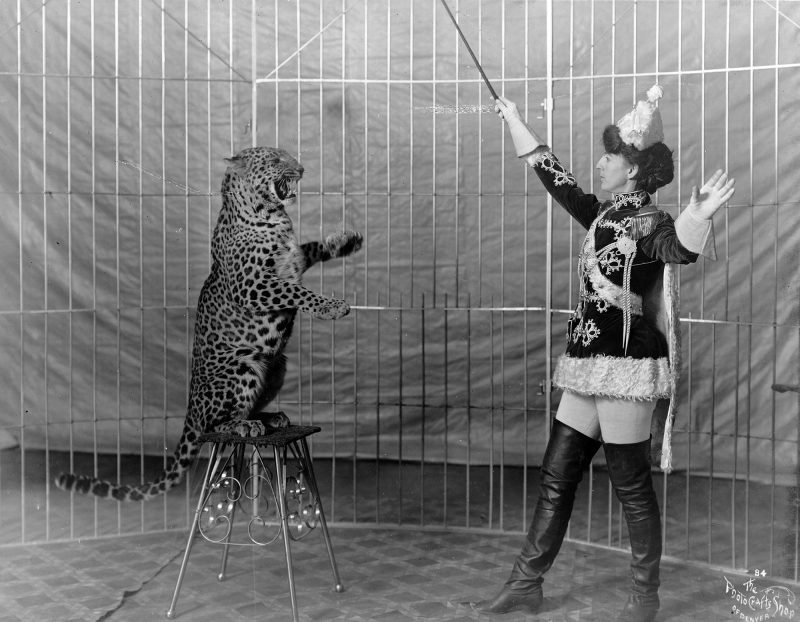
victorian circus with tigers
Circus act with tigers

Victorian era circuses were a part of its culture as it was regarded as a form of entertainment. By the mid-Victorian period, there were numerous circuses which were running their shows in England.
The rise of the circus from mere a performance of artists to being a form of entertainment for the Victorian people was because of its demand. During the Victorian period, only a certain class of society would watch the circus, but after its popularity all the classes watched it.

Common circus acts

The impact of these circuses was so powerful that even the 19th-century theaters included circus acts like jugglers, aerial acts, etc. Trapeze wires were strung from the roofs of these theaters and the artists would show their acts above the crowd of people sitting in the stalls.


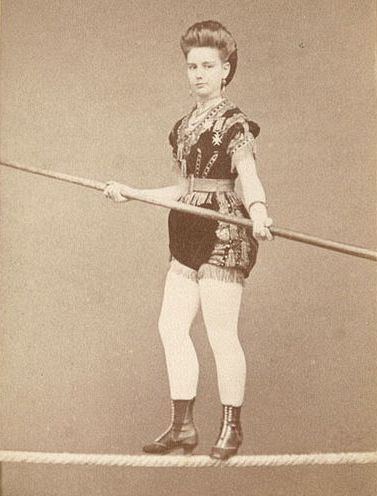
victorian circus ropewalk
Circus ropewalk

The Victorian circuses included skilled artists who performed the dangerous tricks and the basic goal of these circuses was to create excitement amongst the audience. In the event of the circus being in the open air, only a ring of rope was placed on the floor within which the entertainers performed their acts. A wooden barrier was kept from where the audience enjoyed the performances. If the circus was in the evening or night, candles were stacked on the wooden barriers to enable the spectators to watch the circus.
The earliest circuses which operated in Britain comprised of small groups of entertainers which performed their acts and were normally seen at fairs. This small troupe of artists included an equestrian clown, a tightrope walker, and a couple of horses which helped in pulling the wagon when these artists would be traveling.
The circus during the Victorian period would include a performance of artists of an actual battle scene, Chinese jugglers, clowns, female acrobats and even child performers. The trick riding was an important performance which was a part of every circus which operated in Britain and the other acts changed from circus to circus. The aquatic circus was one of the acts developed during this time.
In this act, the circus ring would be flooded with water. However, although these acts provided the audience with entertainment, it should be taken into account that the performances acted out by the performers were extremely dangerous. The famous circus proprietors during the Victorian period were Banister and West, Price and Powell, Abraham Saunders, Lord George Sanger, Frederick Charles Hengler, etc.
The Industrial Revolution of the 19th century brought along new inventions and developments which proved to be very useful to the circuses. With the help of these inventions, the circuses in Victorian England could develop new skills and techniques which mesmerized the audiences.
One of the key factors that helped circus become so appreciated was the fact that the entertainers or artists who performed at these circuses traveled from place to place for their audience, even if it was the smallest town. This touring circus was also known as Tenting circus, which became popular in the 19th century.
The circuses with a large number of artists were known to announce their arrival in a town with the help of circus parade which was successful in drawing the attention of a larger population.
With the growth of railways, these performers were able to travel to the remotest areas which were earlier cut-off from the rest of the places. Thus, it can be seen that the circus which began as an act performed only in fairs became a popular form of commercial entertainment for the people during the 19th century.
Here are some more circus images:


victorian circus performers costumes
Performers costumes
victorian circus
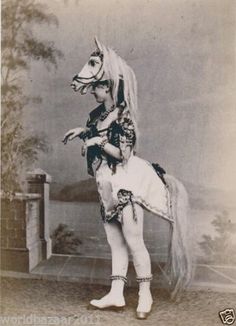
Circus performer fancy dress


victorian circus performers costumes

Le Chat Noir, --- "The Black Cat Cafe" In Bohemian Montmartre, Paris...

Le Chat Noir  (French for "The Black Cat") was a nineteenth-century entertainment establishment, in the bohemian Montmartre district of Paris. It opened on 18 November 1881 at 84 Boulevard de Rochechouart by the impresario Rodolphe Salis, and closed in 1897 not long after Salis' death.
Le Chat Noir is thought to be the first modern cabaret:[ a nightclub where the patrons sat at tables and drank alcoholic beverages while being entertained by a variety show on stage. The acts were introduced by a master of ceremonies who interacted with well-known patrons at the tables. Its imitators have included cabarets from St. Petersburg (Stray Dog Café) to Barcelona (Els Quatre Gats).
Perhaps best known now by its iconic Théophile Steinlen poster art, in its heyday it was a bustling nightclub that was part artist salon, part rowdy music hall. From 1892 to 1895 the cabaret published a weekly magazine with the same name, featuring literary writings, news from the cabaret and Montmartre, poetry, and political satire.
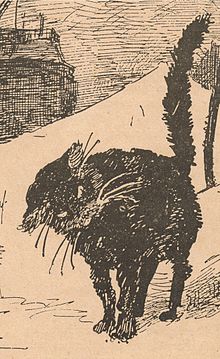
Detail from LE CHAT NOIR journal, number 152, 6 Decembre 1884.
The cabaret began by renting the cheapest accommodations it could find, a small two-room site located at 84 Boulevard Rochechouart, (now commemorated only by a historical plaque). Its success was assured with the wholesale arrival of a group of radical young writers and artists called Les Hydropathes ("those who are afraid of water – so they drink only wine"), a club led by the journalist Émile Goudeau. The group claimed to be averse to water, preferring wine and beer. Their name doubled as a nod to the "rabid" zeal with which they advocated their sociopolitical and aesthetic agendas. Goudeau’s club met in his house on the Rive Gauche (left bank), but had become so popular that it outgrew its meeting place. Salis met Goudeau, whom he convinced to relocate the club meeting place across the river on rue de Laval (now rue Victor-Massé).

Second site
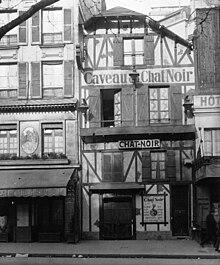
Second location of Le Chat Noirwas 12 Rue Victor-Massé Paris (image from 1929)
Le Chat Noir soon outgrew its first site. In June 1885, three and a half years after opening, it moved to larger accommodations at 12 Rue Victor-Massé. The new venue was the sumptuous old private mansion of the painter Alfred Stevens, who, at Salis' request, transformed it into a "fashionable country inn" with the help of the architect Maurice Isabey. On 10 June 1885, with great fanfare, Salis moved to new premises at 12 Rue Victor-Massé.
Soon, a growing crowd of poets and singers gathered at Le Chat Noir, which offered an ideal venue and opportunity to practice their acts before fellow performers, guests and colleagues.
With exaggerated, ironic politeness, Salis most often played the role of conférencier (post-performance lecturer, or master of ceremonies). It was here that the Salon des Arts Incohérents (Salon of Incoherent Arts), shadow plays, and comic monologues got their start.
The last shadow play by Salis's company was staged in January 1897, after which Salis took the company on tour. Salis was talking of plans to move the cabaret to a location in Paris itself, but he died on 19 March 1897.
The death of Rodophe Salis in 1897 spelled the end of the Chat Noir. By that time, the fascination for Montmartre had already diminished, and Salis had already disposed of many of the club’s assets and facilities. Soon after Salis’ death, the artists dispersed, and Le Chat Noir slowly disappeared.

Last location

Modern appearance of the last site of Le Chat Noir at 68, Boulevard de Clichy
Ten years later, in 1907, Jehan Chargot opened an eponymous café in an effort to resurrect, modernize, and continue the work of his illustrious predecessor. This new Chat Noir, located at 68, boulevard de Clichy, remained popular into the 1920s.
Today, a neon sign which incorporates Steinlen’s iconic Chat Noir image is on display at 68, Boulevard de Clichy, now the site of a hotel by the same name.
Other cabarets successfully copied and adapted the model established by the Chat Noir. In December 1899, Henri Fursy opened his Boîte à Fursy cabaret in the former Chat Noir hôtel on rue Victor-Massé. He claimed to have inherited the mantle of Salis, and said his cabaret "has thanks to Fursy become once again the goal of all who 'climb Montmartre' to hear their favorite chansonniers..."

Shadow play

Under the management of Rodolphe Salis, Le Chat noir produced 45 théatre d'ombres (shadow play) shows between 1885 and 1896, as the art became more popular in Europe. Behind a screen on the second floor of the establishment, the artist Henri Rivière worked with up to 20 assistants in a large, oxy-hydrogen backlit performance area and used a double optical lantern to project backgrounds. Figures were originally cardboard cutouts, but zinc figures were used after 1887. Various artists took part in the creation, including Steinlen, Adolphe Willette and Albert Robida. Caran d'Ache designed around 50 cutouts for the very popular 1888 show L'Epopée.

Cultural associations]

A poster of "Le Chat Noir" may be seen prominently in the crime scene photographs from the 2001 murder of Kathleen Peterson by her husband and novelist Michael Peterson. Le Chat Noir is the name of the nightclub where Frank Sinatra and Natalie Wood rekindle their relationship, in the 1958 movie Kings Go Forth. There is also the famous cat painting with blinking eyes on the entrance wall.

Tuesday, August 28, 2018